
How Do I Create a Low-Maintenance Front-Yard Landscaping Plan?
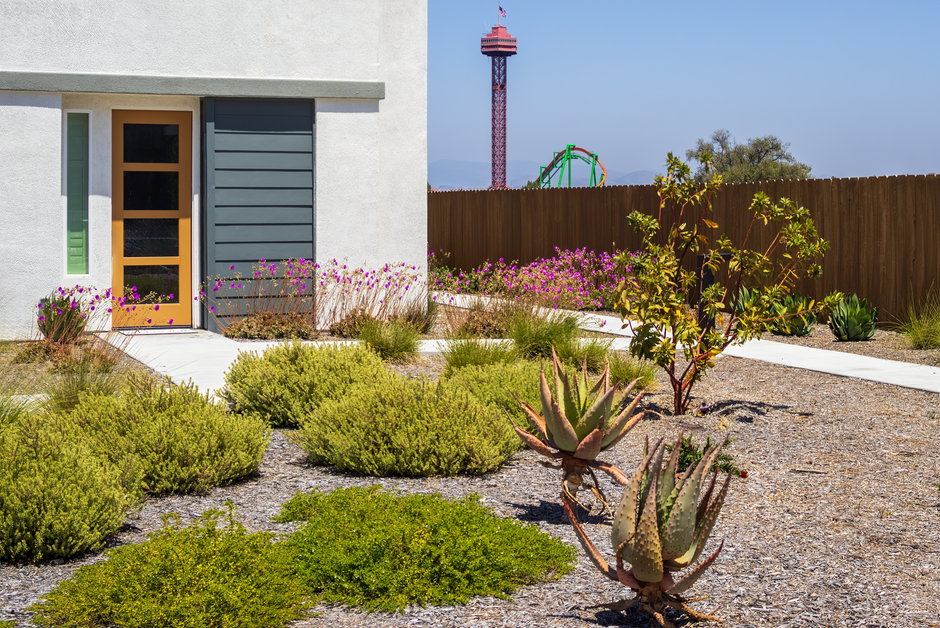
Create a low-maintenance front yard by mapping sun, drainage, utilities, views, and mature plant dimensions before buying plants; then build one layered bed with shrubs, seasonal color, and groundcover. Keep shrubs about 2 feet from the house at mature size, use 3-4 inches of mulch, and choose plants suited to each area's light and moisture.
A front yard fails slowly. A shrub reaches the window. Water settles where roots cannot use it. A narrow walk becomes narrower.
The fix begins before the nursery.
How do I landscape the front of my house on a budget?
Landscape the front of your house on a budget by paying first for a clear bed edge, mulch, and the entry area, then adding appropriately sized plants in stages.
Spend on the parts that define the picture. Bed lines make a small planting read as intentional. Mulch makes bare soil read as finished. The path to the front door deserves the strongest structure because it is the view every visitor sees.
Buy smaller container plants when time is available. Mississippi State University Extension states that smaller plants of the same type cost less than larger ones. The saving has a cost: space must remain open while plants grow. Empty space is not a mistake when the mature plan is sound.
Use a phased order.
- Mark the bed boundary and circulation routes.
- Install the largest structural plants at their mature spacing.
- Add groundcover or low plants where bare soil would otherwise invite weeds.
- Finish with a 3-4 inch layer of organic mulch, the depth recommended by the EPA WaterSense program.
Do not buy plants to fill every gap on day one. Crowding creates future pruning, replacement, and blocked views. A measured plan is also a useful habit in other practical work, as this site explains in How Do Manufacturers Turn an Automation Expo Demo Into a Measurable AI Pilot?.
What plants should I put in front of my house?
Put plants in front of your house only after matching their light, soil, moisture, mature size, and upkeep needs to the exact spot where they will grow.
The University of Minnesota Extension calls for a site evaluation that records structures, topography, existing plants, soil, utilities, service areas, and visual needs. This turns plant shopping into selection rather than guesswork. Its central rule is plain: put the right plant in the right place.
Full sun means at least 6-8 hours of direct sunlight, according to Mississippi State University Extension. Map those hours across the front yard rather than labeling the whole yard sunny or shady. A bed beside a wall, under a tree, or near a porch can contain different light conditions within a few steps.
| Plant layer | Job in the bed | Planning rule |
|---|---|---|
| Evergreen or structural shrub | Provides year-round form | Select mature height and width for windows, walks, and wall space. |
| Seasonal flowering plant | Adds changing color | Match it to the recorded sun, soil, and moisture conditions. |
| Groundcover | Covers broad low areas | Use spreading forms only where their mature spread has room. |
Use native and pollinator-supporting choices through a regional filter, not a universal plant list. The supplied public guidance supports regionally appropriate native plants, but it does not name a single plant that fits every climate zone. Local extension guidance or a regional native-plant reference is needed for species names.
How far from the foundation should shrubs and plants be planted?
Plant foundation shrubs so they retain an approximately 2-foot gap from the house at mature size, leaving air circulation and access for upkeep.
University of Florida IFAS Extension separates mature plant sizes into small plants at 2 feet or shorter, medium plants at 2-4 feet, and large plants at 4-6 feet or higher. Those ranges are design tools. A plant's label gives the future footprint; the planting hole is only its starting point.
Measure from the mature edge of the shrub, not from its trunk. Leave room for windows to stay visible, paths to stay passable, and the wall to remain reachable. Tall, narrow forms suit narrow spaces. Wide, spreading forms need a deeper bed.
Plants should follow the house without swallowing it. Structure is calm. Overgrowth is work.
How do I design a front garden bed that looks good year-round?
Design a front garden bed for year-round appeal by combining a stable structural layer, a changing seasonal layer, and a low groundcover layer while giving each plant room to reach its mature form.
Start with the site map. University of Florida IFAS Extension recommends mapping sun and shade, dry and wet areas, soil type, views, wind, circulation, dimensions, architecture, and activity needs before plant selection. The layout follows from those facts.
Place the tallest plants where they frame rather than block. Set medium shrubs forward of them. Use low plants and groundcover at the edge. This creates depth from the street and keeps the foreground from hiding the entrance.
Drainage belongs in the design, not in a later repair. IFAS advises matching plants to natural moisture conditions, since low areas stay wetter and berms or high points do not suit plants that need high water. For a slope, the EPA states that native groundcovers and deeper-rooted shrubs can help stabilize soil and limit runoff.
A rain garden is a distinct tool for runoff, not a decorative low spot. The EPA Office of Water describes it as a landscaped depression that collects runoff and filters it through soil, sand, or gravel. Its bottom requires plants that tolerate wet and dry periods; its edges suit upland plants. Site-specific soil testing guides that design.
Frequently Asked Questions
What are low-maintenance landscaping ideas for a sunny front yard?
Use plants suited to full sun, defined by Mississippi State University Extension as at least 6-8 hours of direct sunlight, and group them by water needs. Add organic mulch 3-4 inches deep to curb weeds, reduce evaporation, and moderate soil temperature. Regionally appropriate native and low-water plants need little water beyond normal rainfall once established, according to the EPA.
How do I landscape a front yard with poor drainage or a slope?
Match plants to the site's natural moisture pattern: wetter plants belong in low areas, while plants that need drier conditions belong on higher ground. On slopes, native groundcovers and shrubs with deeper root zones help stabilize soil and reduce erosion and runoff. A rain garden needs site-specific soil testing and planting zones that account for alternating wet and dry conditions.
Which shrubs will not grow too large and block windows or walkways?
Choose shrubs by their mature height and width, not by the size of the container at purchase. University of Florida IFAS Extension classifies small plants as 2 feet or shorter and medium plants as 2-4 feet; these categories help frame choices for low windows and narrow walks. Mississippi State University Extension warns that oversized shrubs commonly block windows, driveways, and walkways.
Sources
- University of Minnesota Extension: Lawns and Landscapes in Minnesota
- University of Florida IFAS Extension: The Florida-Friendly Landscaping Guide to Plant Selection and Landscape Design
- University of Florida IFAS Extension: Basic Principles of Landscape Design
- U.S. Environmental Protection Agency WaterSense: Landscaping Tips
- U.S. Environmental Protection Agency Office of Water: Bioretention and Rain Gardens
- Mississippi State University Extension: Selecting Landscape Plants